 ultimate-guide
Interfaith Wedding Ceremony Script Examples & Guide
Table of Contents
- Interfaith Wedding Ceremony Script Examples: A Complete Framework
- How to Blend Religions in a Wedding Ceremony: Step-by-Step
- Interfaith Wedding Vows: Writing Promises That Honour Both Traditions
- Interfaith Wedding Ceremony Readings and Poems
- Interfaith Wedding Ceremony Script: Rituals From Two Faiths
- Working With an Officiant: Legal Requirements and Coordination
- Frequently Asked Questions
Last Updated: October 7, 2026
Interfaith Wedding Ceremony Script Examples: A Complete Framework
An interfaith wedding ceremony script is a written order of service that combines elements from two religious or cultural traditions into one coherent ceremony, with wording adapted so both partners and both families feel represented.
The Core Structure Every Interfaith Script Follows
Nearly every workable interfaith wedding ceremony script follows the same skeleton:
- Processional and welcome (2-3 minutes)
- Opening remarks and acknowledgment of both traditions (3-5 minutes)
- Readings or poems (one from each background, 4-6 minutes)
- Ritual or rituals (5-10 minutes)
- Exchange of vows and rings (5 minutes)
- Blessing and closing words (3 minutes)
- Declaration and recessional (2 minutes)
What changes between couples is the content inside each block, not the block itself.
Sample Opening Remarks and Welcome
The welcome sets the tone. Here is a template to adapt:
"Welcome, family and friends. We gather today to witness the marriage of [Partner A] and [Partner B]. Theirs is a marriage of two hearts and two traditions. [Partner A] brings the heritage of [Tradition A], and [Partner B] brings the heritage of [Tradition B]. Today we honour both, and we celebrate the common ground they share: a commitment to love, to family, and to a life built together. Please be seated."
Three rules apply: name both traditions explicitly so neither family feels sidelined; keep the language inclusive rather than doctrinal; and alternate the order of mention between welcome and closing so neither tradition ranks above the other.
How to Blend Religions in a Wedding Ceremony: Step-by-Step
Blending religions in a wedding ceremony works best when you treat the two traditions as parallel streams rather than one hybrid. Each gets its own moment, wording, and ritual, held together by neutral connective language. Here is how planning can be sequenced:
Step 1: List what each family considers non-negotiable. Ask both sets of parents and both partners separately. Common examples: a specific blessing, a reading in a particular language, or a ritual performed by a relative.
Step 2: Map the overlaps. Most traditions share a blessing, a vow exchange, a ring or token, and a communal moment, your shared ceremony elements.
Step 3: Assign each unique element its own slot. A Jewish chuppah and breaking the glass, or a Muslim Nikah and dua, each get a distinct section.
Step 4: Write neutral transitions. The celebrant's lines between traditions are what make the ceremony feel unified rather than stitched together.
Step 5: Run the full script past both families before the rehearsal. Objections caught two weeks out are fixable.
Interfaith Wedding Vows: Writing Promises That Honour Both Traditions
Interfaith wedding vows work best in three layers: a shared vow both partners say together, a personal vow each writes alone, and an optional faith-specific vow from one or both traditions. This honours religious commitments without forcing promises either partner does not hold. The examples below are written for specific faith pairings, because wording that works for a Jewish-Christian couple will not work for a Muslim-Christian or Hindu-Christian couple.
Jewish and Christian Vows
Shared vow: "We promise to honour, nurture, and protect one another, in times of joy and in times of difficulty, for as long as we both shall live."
Jewish-specific vow (Partner A): "I promise to build a Jewish home with you, to keep the traditions that shaped me, and to make room for the traditions that shaped you."
Christian-specific vow (Partner B): "I promise to love you as I have been taught to love, to walk with you in faith, and to honour the covenant we make today."
Note: The Jewish vow says "a Jewish home" rather than "a kosher home" or "a Sabbath-observant home," because observance is a private decision. Keep the vow at commitment, not practice.
Hindu and Christian Vows
Shared vow: "We promise to walk together through every season of life, to support one another's faith, and to build a home where both traditions are honoured."
Hindu-specific vow (Partner A): "I promise to honour the vows taken before the sacred fire, to respect the paths of our families, and to walk with you in dharma."
Christian-specific vow (Partner B): "I promise to love you as Christ loved, to serve you and our family, and to keep faith with you in all things."
Note: "Dharma" does not translate neatly into English. If guests are unfamiliar, the celebrant can add: "Dharma is the Hindu idea of living in accordance with one's duty and the natural order."
Muslim and Christian Vows
Shared vow: "We promise to honour one another, to seek mercy together, and to build a life rooted in love and mutual care."
Muslim-specific vow (Partner A): "I promise to honour the covenant of Nikah, to care for you as the Qur'an instructs, and to raise our children with knowledge of both traditions."
Christian-specific vow (Partner B): "I promise to love you as I have been loved, to forgive as I have been forgiven, and to walk beside you in faith."
Note: The Nikah is a contract as well as a covenant, so the vow wording must not contradict the contract terms. Review both documents side by side before the rehearsal.
Secular and Religious Vows
Shared vow: "We promise to honour one another's beliefs, to build a home where both are welcome, and to face whatever comes together."
Secular partner's vow: "I promise to respect what you hold sacred, to stand with you in your practice, and to never ask you to choose between your faith and me."
Religious partner's vow: "I promise to love you without condition, to share my tradition without imposing it, and to make room for the beliefs that shape you."
Note: The secular partner's vow does the heavy lifting, reassuring the religious partner's family that the marriage will not pull their child from the tradition.
Inclusive Wording Alternatives
Interfaith couples often need to adjust traditional vow language to avoid misrepresenting either partner's beliefs. Common substitutions:
| Traditional wording | Inclusive alternative | When to use it |
|---|---|---|
| "Under God" | "In the presence of those we love" | When one partner is secular or the traditions use different names for the divine |
| "Obey" | "Honour and support" | Almost always, unless both partners specifically want the traditional wording |
| "Until death parts us" | "For as long as we both shall live" | When one tradition's afterlife language differs from the other's |
| "According to God's law" | "According to the commitments we make today" | When the couple wants the vow to stand on its own, not on doctrine |
| "Man and wife" | "Husband and wife" or "partners in marriage" | When gender roles in the traditional wording do not reflect the couple's values |
| "Bless this union" | "Bless this marriage" or "Honour this commitment" | When one tradition does not use the word "union" in this context |
How to Brief a Co-Officiant on Vow Wording
If a religious figure and a registered celebrant share the ceremony, the vows are the likeliest point of friction: the religious figure often wants the faith-specific vow first, the celebrant the legal vow. Separate them, the faith-specific vow during the ritual section, the legal vow during the exchange of vows, with the celebrant confirming the legal wording in advance.
Three things to agree in writing before the rehearsal:
- Who says the legal vow wording. In most ceremonies, the celebrant prompts and the couple repeats. Confirm the religious figure does not override this.
- Which language the vows are spoken in. If one vow is spoken in Arabic, Hebrew, Sanskrit, or another language, agree whether an English translation follows, and by whom.
- What happens if a partner stumbles. Agree that the celebrant will prompt rather than correct, and that the religious figure will not add commentary mid-vow.
If you want further wording inspiration, the Australian Government's marriage celebrant guidance outlines what a legally valid vow must contain, which is a useful boundary to write within.
Interfaith Wedding Ceremony Readings and Poems
Readings and poems carry meaning without carrying doctrine. Choose two or three: one from each faith background plus one neutral piece.
Strong options include:
- From Islamic tradition: passages from the Qur'an on marriage as a source of tranquillity and mutual care, read in Arabic with an English translation.
- From Jewish tradition: the Seven Blessings, or a passage from Song of Songs.
- From Christian tradition: 1 Corinthians 13, or a passage from Ruth on loyalty and belonging.
Interfaith Wedding Ceremony Script: Rituals From Two Faiths
Rituals make an interfaith ceremony memorable because guests watch rather than only listen. Pair rituals that occupy similar emotional space so the ceremony does not lurch between moods.
Rituals That Pair Well Together
| Ritual Pairing | Why It Works | Best For |
|---|---|---|
| Chuppah + Nikah contract signing | Both frame the marriage as a public covenant | Jewish-Muslim ceremonies |
| Breaking the glass + wine blessing | Both mark a transition with a shared physical act | Jewish-Christian ceremonies |
| Hora + communal dua | Both invite guests into the celebration physically | Ceremonies with large extended families |
| Ring exchange + exchange of garlands | Both are visible, symmetrical, and easy for guests to follow | Hindu-Christian ceremonies |
The pairing rule is simple: put the two rituals back to back, and have the celebrant explain each in one sentence beforehand. Guests who understand what they are watching participate rather than observe.
For couples wanting the Islamic Nikah handled with both religious and legal care, this is exactly the ground Ceremonies With Faisal works on.
Working With an Officiant: Legal Requirements and Coordination
An interfaith officiant does two jobs at once: they hold the ceremony together emotionally, and they make sure it is legally valid. In Australia, a marriage must be solemnised by a registered marriage celebrant or a minister of religion registered under the Marriage Act 1961, and the legal requirements apply regardless of how many religious elements you include.
The practical sequence looks like this:
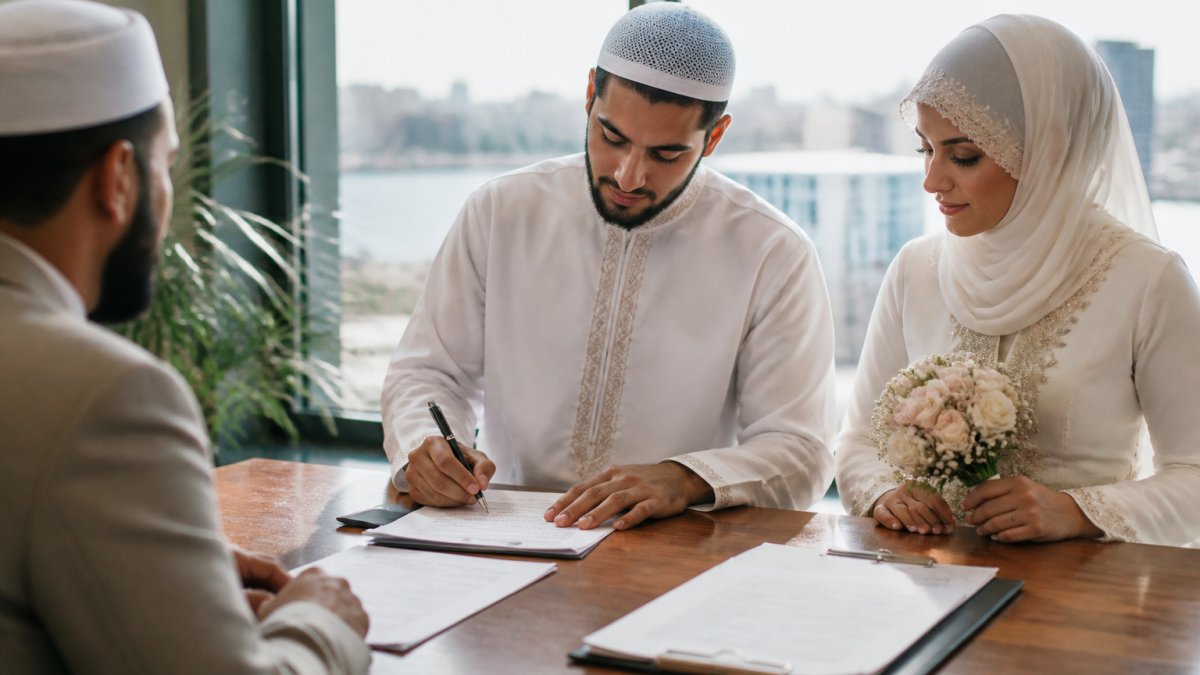
- Notice of Intended Marriage must be lodged with your celebrant at least one month before the ceremony, and no more than 18 months ahead.
- Identity and eligibility documents must be sighted by the celebrant before the ceremony.
- Two witnesses aged 18 or over must be present and sign the certificates.
A co-officiant arrangement, where a religious figure and a registered celebrant share the ceremony, is common for interfaith couples. Decide early who says what, and put it in the script in bold so nobody improvises.
Planning an interfaith ceremony means holding two sets of expectations, two family histories, and one legal framework in the same hour, a lot to carry alone, and where experienced guidance makes the difference. Ceremonies With Faisal brings together a registered marriage celebrant's understanding of Australian legal requirements and an experienced Sheikh's grounding in Islamic tradition, so your Nikah, civil marriage, or interfaith ceremony is both spiritually meaningful and legally compliant.
Frequently Asked Questions
How do you write an interfaith wedding ceremony script?
Start by listing the elements each partner wants from their tradition, then find where they overlap or can sit side by side. Build a structure: welcome, opening remarks, readings, vows, rituals, closing blessing. Write inclusive language that names both traditions without ranking them. If one partner's family has concerns, address those in the wording early. A celebrant experienced in interfaith weddings can help draft and refine the script so it flows naturally and respects both backgrounds.
Can an interfaith wedding ceremony include religious and non-religious readings?
Yes. Many interfaith couples choose one reading from each faith tradition alongside a secular poem or passage. This balance signals respect for both backgrounds and gives guests from either side something familiar. For example, you might include a passage from the Quran, a Bible reading, and a poem by a well-known author. The key is to introduce each reading briefly so guests understand its origin and why it matters to you as a couple.
How long should an interfaith wedding ceremony script be?
Most interfaith ceremonies run 30 to 45 minutes. The script itself typically covers 15 to 25 minutes of spoken content, with the rest filled by music, processional, and recessional. If you are including multiple rituals, readings from two traditions, and personalised vows, aim for the longer end. A ceremony that feels rushed does not give guests time to absorb the meaning. Your celebrant can help you pace the script so every element gets room to breathe.
Who can help write or lead an interfaith wedding ceremony?
A registered marriage celebrant with experience in interfaith ceremonies is the best starting point. In Australia, your celebrant handles the legal requirements, including the Notice of Intended Marriage, and can guide the ceremony structure. If you want religious elements led by a faith leader, you may need a co-officiant arrangement. Some couples use a celebrant for the legal portion and a religious leader for blessings or prayers. Discuss this early so the timing and roles are clear.
What rituals work well in an interfaith wedding ceremony?
Rituals that are visual and participatory tend to work best because they engage guests from both backgrounds. Common pairings include a chuppah with a wine blessing, or a ring exchange alongside a unity candle. You can also create a new ritual that reflects your shared values, such as planting a tree or blending two colours of sand. The goal is to choose rituals that feel meaningful to you, not just traditional. Your celebrant can explain the origins so you can decide what fits.
How do we explain interfaith ceremony traditions to guests?
Include short explanations in the ceremony script itself. Before each ritual or reading, the celebrant can say a sentence or two about where it comes from and what it symbolises. You can also print a program that lists each element with a brief note. This helps guests from both sides feel included rather than confused. If one tradition is less familiar to most guests, a slightly longer introduction works well without slowing the ceremony.